This weekend, in attempt to get started on a project, I ended up going to four different libraries. They were all different and had their own unique qualities. When browsing these libraries, I noticed different things and personally evaluated them with the consideration of space that Professor Lankes mentions in his book. Here is my breakdown of the four libraries.
Bird Library: I'm sure every SU LIS student has been to Bird before, but this weekend was the first time I've been beyond the first floor. I found myself situated at multiple spots on the 2nd floor (I went to Bird twice this weekend). One thing I noticed is that the areas labelled "QUIET" are hardly followed. I think the problem arose from the fact that the area of available computers, where people were printing (and trying to fix the printers) was noisy and unfortunately located right next to tables where people were trying to get work done. I had a hard time stopping myself from giving multiple people the "stink eye". I also ran into some confusion when I was searching through the Reference area on the 2nd floor. One small area is labelled Reference; however, many of the Reference books I was searching for were eventually found beyond the region of Reference. In fact several of my searches led me to the other floors. I'm convinced that the 3rd floor has a missing section of call numbers. Also, I was too embarrassed to actually ask for help due to the fact that I have pride as a Library student and therefore believe that my searching skills are adequate and that it's not "user error" that I can't find my book, haha. Lastly, even though I knew (and read signs) that a large chunk of the stacks had been moved to Carnegie Library, I still tried to reach the 6th floor of Bird. I almost got stuck in an elevator and eventually reread signs and found my book in the 5th floor. The moral of that story is that SU Library needs to change their online catalog so that it doesn't tell me my book's found on the (unreachable, so far) 6th floor.
Carnegie Library: I was fortunate to be invited to a tour of SU's Carnegie Library. After trying many doors, I found the entrance that was not under construction. Obviously the library looks a lot different than Bird, especially because of all the construction. However, I loved the intimacy and tight quarters of the library. There was a more serious tone to this library; Carnegie focuses on the science and math subjects (and library science, though that was a surprise to me, even after 2.5 months into the program!) and therefore the library members are those who use the library mainly as a research area, not as a social space. Though it makes the reconstruction of the building more difficult, I loved how the stacks were a part of the structure of the building. Books literally hold this place together. Touring Carnegie was like an experience through a time machine. The stairs for each level wrapped around a dumbwaiter which is used for the transportation of books. I can't wait to see Carnegie Library once the construction is done. I am certainly intrigued by the idea of specialized libraries and I believe I could get some serious work done at a place like that.
Manlius Public Library: Besides the Fayetteville Free Library, this is the first public library I have been to since I've been in Syracuse. I loved that there was a pond and park right by the library. There's nothing wrong with aesthetics at library, even if it is outside. When I entered, I noticed that the children's section was enclosed in it's own room. I liked that because it allows for noise control; I can imagine story hour and any event that the library puts together for the children not being so disruptive to the rest of the library. Like my library at home, the teen section is the area with the most work tables. I searched the library for a computer to search for some books. While there were quite a few computers, they were not easy to access, because they required a log-on username and password. I am not used to this kind of difficulty. At my local library at home, anyone can access a computer without having to enter a password or a library card number. Most of the computers were like that at Manlius; however, I searched around and found about 3 computers just for the library catalog. My last concern about this library was the issue of a book cart. I'm not sure if this is just happens at academic libraries, but usually the library posts signs asking users not to re-shelve books and to leave them on a cart. However, when I looked for a cart, there were none to be found. I felt guilty about leaving my books on the table I worked at, but come on, I'm just helping the library evaluate what books are being used, haha!
Petit Library: I went to this library with a friend so that she could check out a children's book for a project. My first observation was that the parking was tiny! I know there's been discussions about this particular issue, and now I understand. Luckily we were able to park, no problems. After entering, my second observation was about the size of the library. It's certainly the smallest library I've ever seen. However, that didn't prevent the community. I guess there was an event going on because there were so many people gathered around talking and eating from a spread of snacks. When we went to the children's section, we looked for a particular dinosaur book. We searched and searched but couldn't find it. After re-checking the online catalog we asked the friendly reference librarian in the children's area. She pointed out that sometimes they pull books for different sections and thankfully we found the book in a crate labelled dinosaurs. Later on, I noticed this same librarian chatting with a small boy. She seemed to know him by name and was asking him about school. I loved how the library and librarians at Petit really try to reach out to their community.
All in all, I saw a lot of cool (and frustrating) library practices going on. These visits helped me open my eyes to see how different each library is and to understand that handling space in the library is what you (librarians) make of it.
Monday, October 15, 2012

Tuesday, October 9, 2012
Relate and Debate
This past weekend I went to my home state of Virginia to visit my boyfriend and his family. During those three days I spent my time (besides relaxing and simultaneously stressing about my homework) talking to people about grad school and the program of Library Science. It made me laugh that even during this mini-break, I can't seem to get out of my library persona. Here are the multiple situations I found myself in, through the format of a list.
1. I was gifted a Kindle and had an internal debate about how I was giving up my stubborn stance for the protection and continuation of books in print. While the English major in me still loves a good book that I can write in and bend the pages, the New Librarian in me had some convincing points. When I was traveling from Syracuse to Virginia, and then back again, I found how convenient it would've been to have just brought my Kindle instead of lugging my thick 800 page Anna Karenina with me on the plane. Not just that, but I discovered today that my public library back at home (of which I am still a member) allows members to check out copies of e-books that can be transferred to my Kindle. They're free and when I'm done reading, I can just return it back to the library; that will take up less space and use less data. I'm slowly embracing this new technology and as my boyfriend told me "it's the advancement of the world, Erin. It's ok. We don't still watch tv in black and white either". Haha.
2. Over a few drinks I had a debate with my boyfriend's twin about the Dewey Decimal system and the Library of Congress Classification. He was convinced that his school used Dewey and that it the call number had letters. I aggressively responded and told him that there's no way the classification was Dewey (since Dewey only uses numerals) and that it was actually the Library of Congress Classification system. I literally gave the line "You should listen to me; I'm the librarian here!"
3. Throughout the weekend I tried my best to relate how librarians are useful in the world. I talked with a few law students and told them that librarians work just as hard as they do. I received a few nods. The hardest person I had to deal with was my own boyfriend. He didn't understand what I was studying in Library school. After pulling my massive binder out and letting him browse, I told him about the interview assignment that we had to do for IST 511. When I told him that a fellow classmate of mine had interviewed WWE's one and only librarian, he was shocked. I think that at that point I reached out to him. He is a huge MMA fan (so much that he could be an asset to the MMA/UFC library, if there was one) and when he heard from me that even professional wrestling companies needed a library, I think he understood that libraries and the need for an organization of information, as well as the need for a librarian, was necessary for "the advancement of the world", to quote him directly again. I think this agrees with Lankes point that librarians need to reach out to their members to find their interests and provide them with the information they want.
Libraries, you can't escape them.
1. I was gifted a Kindle and had an internal debate about how I was giving up my stubborn stance for the protection and continuation of books in print. While the English major in me still loves a good book that I can write in and bend the pages, the New Librarian in me had some convincing points. When I was traveling from Syracuse to Virginia, and then back again, I found how convenient it would've been to have just brought my Kindle instead of lugging my thick 800 page Anna Karenina with me on the plane. Not just that, but I discovered today that my public library back at home (of which I am still a member) allows members to check out copies of e-books that can be transferred to my Kindle. They're free and when I'm done reading, I can just return it back to the library; that will take up less space and use less data. I'm slowly embracing this new technology and as my boyfriend told me "it's the advancement of the world, Erin. It's ok. We don't still watch tv in black and white either". Haha.
2. Over a few drinks I had a debate with my boyfriend's twin about the Dewey Decimal system and the Library of Congress Classification. He was convinced that his school used Dewey and that it the call number had letters. I aggressively responded and told him that there's no way the classification was Dewey (since Dewey only uses numerals) and that it was actually the Library of Congress Classification system. I literally gave the line "You should listen to me; I'm the librarian here!"
3. Throughout the weekend I tried my best to relate how librarians are useful in the world. I talked with a few law students and told them that librarians work just as hard as they do. I received a few nods. The hardest person I had to deal with was my own boyfriend. He didn't understand what I was studying in Library school. After pulling my massive binder out and letting him browse, I told him about the interview assignment that we had to do for IST 511. When I told him that a fellow classmate of mine had interviewed WWE's one and only librarian, he was shocked. I think that at that point I reached out to him. He is a huge MMA fan (so much that he could be an asset to the MMA/UFC library, if there was one) and when he heard from me that even professional wrestling companies needed a library, I think he understood that libraries and the need for an organization of information, as well as the need for a librarian, was necessary for "the advancement of the world", to quote him directly again. I think this agrees with Lankes point that librarians need to reach out to their members to find their interests and provide them with the information they want.
Libraries, you can't escape them.
Sunday, September 30, 2012
In With the New
When reading the Librarians thread of Lankes' The Atlas of New Librarianship, I found a blurb that really stood out to me. When Lankes mentions that one day "we will discard modifiers like 'participatory' and 'new' and simply be librarians, part of a better society, respected by our communities, and devoted to our members" (187). It's interesting, because when I was reading the Atlas, I didn't really focus on the "new" aspect of librarianship. When I started applying to Library Science programs, I (naively) believed that there was nothing wrong with libraries. What I mean is that I was satisfied with what I had experienced throughout my many years of visiting libraries. I didn't realize that as I entered this field that there was a major change, or to be dramatic, a revolution in the world of libraries. I have no objection to the ideas presented in this textbook. In fact, I'm glad that my lack of experience in the library field means that I don't have to be "retaught"; I have a fresh start.
I'm glad Lankes connects Library Science to other fields. As an English major I figured that I would do well in Library Science. But it's more than a love of books (or artifacts). A really good point was made that not only does my specialized degree in humanities provide me with a strength in analyzing texts, but humanities has provided me with a way of seeing society as a large conversation and it helps me to understand the importance of social compacts (176). That's why it's so great to have a diversity of knowledge in the library field. So many people can offer multiple conversations and they can become valuable resources in the library.
The Atlas is a great text for new librarians to read. However, because of its inspirational nature, it definitely has me itching to get into the nitty-gritty of library skills so that I can use my unique individual skills to impact whatever library and community I work with in the future.
I'm glad Lankes connects Library Science to other fields. As an English major I figured that I would do well in Library Science. But it's more than a love of books (or artifacts). A really good point was made that not only does my specialized degree in humanities provide me with a strength in analyzing texts, but humanities has provided me with a way of seeing society as a large conversation and it helps me to understand the importance of social compacts (176). That's why it's so great to have a diversity of knowledge in the library field. So many people can offer multiple conversations and they can become valuable resources in the library.
The Atlas is a great text for new librarians to read. However, because of its inspirational nature, it definitely has me itching to get into the nitty-gritty of library skills so that I can use my unique individual skills to impact whatever library and community I work with in the future.
Monday, September 24, 2012
Darwinism in Libraries
Darwin is famous for his theories on evolution.


My favorite theory to apply to all aspects of life is the "survival of the fittest." While this theory was originally applied to species that did not last (because they did not adapt), it can be applied to the institution and field of libraries and librarianship. Professor Lankes, in The Atlas of New Librarianship, mentions Ranganathan's fifth law of librarianship: "The library is a growing organism" (128). After reading (and agreeing with) it, the analogy of a library, as a living thing that's always growing and changing, helped me connect libraries with evolution. Now I do not claim to be the first person to think of this, but it's a cool thing to discuss again and again. As man had to develop from ape to an upright homo sapiens who could develop his own tools, so libraries must adapt and develop according to the needs of the community. The introduction of the electronic and digital age has forced libraries and librarians, sometimes uncomfortably, to make the necessary changes. For example, now that e-readers and e-books are becoming more widespread, the policy for developing and maintaining a physical collection isn't going to be as important. Now, I'm not trying to say that, just like some species that died off and can't adapt or survive, books and physical artifacts are going to disappear. I just believe that the act of physically checking out books or searching through reference books are not what the community needs anymore. Libraries and librarians must survive the constant and innovative changes that the community desires, in order to be successful and not stuck in the mentality that libraries are going to die off.
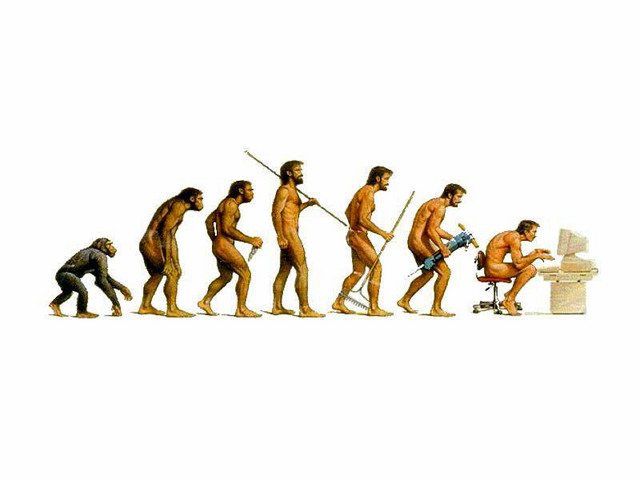
We, as librarians, must evolve and keep up with new developments and help contribute to the new innovations, so that we can maintain a functioning and developing role as facilitators in our communities and in this world.
Good news! We can and have evolved from this:

Sunday, September 16, 2012
Libraries are NOT Doomed...
Libraries are not doomed; however, they do need some serious work. As I was reading The Atlas of New Librarianship, I noticed that there was a recurring issue. Libraries and librarians strive to make library and community members self-sufficient in terms of technology; Lankes points out that by doing this, members are dependent upon the technology and lose touch with the librarians in the process. It's true that "members use systems that help them" but at some point, do librarians feel unnecessary (Lankes, pg. 89)? Every job should promote self-worth, and librarians especially can feel a sense of self-worth when they assist the community. Librarians might not always be the "go-to" person for questions of reference, but as facilitators and coaches of the community members, their role changes, but the act of community service does not disappear. I like the idea of libraries developing writing centers, music centers, and topical centers. That way, the librarians' role in the community is still present, even if they are not just helping catalog books. As David Lankes mentions throughout his entire Atlas, libraries are not just about the artifacts.
Monday, September 10, 2012
A Librarian's Business Card
After reading the thread "Facilitating" from the book The Atlas of New Librarianship I realized that as a librarian there's a lot that can be put on a business card. Sure, it would seem more professional to have the standard and important information on the card, like one's name, official title, and contact information. However, I've found, it's so hard to define exactly what a librarian does with just a title like "Executive Director" or "Reference Librarian".
As Lankes mentions, librarians need to facilitate conversation so that knowledge can be created in communities (65). To provide facilitation, librarians should be publishers, teachers, and moderators. Think how cool it would be for business cards to be like Twitter profiles, where you can create your own blurb about one's profession. For example, my future business card might say:
As Lankes mentions, librarians need to facilitate conversation so that knowledge can be created in communities (65). To provide facilitation, librarians should be publishers, teachers, and moderators. Think how cool it would be for business cards to be like Twitter profiles, where you can create your own blurb about one's profession. For example, my future business card might say:
Erin Berry
Instructor, Publisher, Student, Moderator
Loves: British Literature, crockpot recipes, and Google searching
And why be restricted to a small paper rectangle? I love the idea that Lankes offers about library websites: they should not advertise the library, but rather the librarians (78). I am a not a techie, but I think it would be really neat to have the top of the home page display pictures of the librarians, where you can hover over each librarian and their name and business blurb would appear. That way library members could learn a little about their librarians for they ask for assistance or services.
What would your business card say?
Saturday, September 8, 2012
To Serve Man
Here's another Lio comic strip! I love this one!

There's nothing like sharing a library book with a friend. Good to know that the library has a diverse selection of cookbooks. I wonder what the index of this cookbook looks like (shout-out to IST 616)!
There's nothing like sharing a library book with a friend. Good to know that the library has a diverse selection of cookbooks. I wonder what the index of this cookbook looks like (shout-out to IST 616)!
Subscribe to:
Posts (Atom)